Comments on U5 Process Water Requirements
This letter submitted by Heather Cooley of the Pacific Institute to the California Department of Water Resources, Division of Statewide …

This letter submitted by Heather Cooley of the Pacific Institute to the California Department of Water Resources, Division of Statewide …
A new analysis from the Pacific Institute recommends specific actions that can annually save a million acre-feet of water quickly and at a lower economic and ecological cost than developing new supplies. The assessment notes that new actions are immediately needed to reduce the growing tensions over the state’s water resources and to address California’s persistent water supply challenges.
Now that California lawmakers have pulled an $11 billion water bond measure off the November ballot, California is facing new questions about how to fix our longstanding water problems, including the long-term health of the Sacramento-San Joaquin Delta and the future reliability of our water supply. A number of commentators have praised or pilloried the delay of the bond, but one thing we can all agree on is that California’s water challenges have not gone away. The recent State Water Resources Control Board report that finds we must halve our water withdrawals from the rivers and streams that sustain the Delta is simply one more indication that we have over-tapped California’s precious water resources and that we must find innovative ways to do more with less.
Dear Governor Schwarzenegger:
On behalf of the following undersigned organizations representing environmental, hunting and fishing interests, we write to respectfully urge you to sign SB 51 (Ducheny). This important legislation sets forth the implementing structure for the Salton Sea restoration effort. SB 51 is the product of nearly three years of work and discussion between all of the various interests involved in Salton Sea restoration and reflects a balanced approach for integrating local and statewide interests into the implementation of the Salton Sea Restoration plan.
Global climate change is clearly acknowledged to pose risks to California’s water, though the focus has primarily been on water supply-side changes (e.g. decreased snowpack, earlier snowmelt, and more extreme floods and droughts). Yet along with these shifts in the quantity, timing, and reliability of freshwater supplies, climate change will also have important impacts on water demand. In particular, increased temperatures and altered precipitation patterns will affect the evapo-transpiration of plants and thus, total outdoor water demand. In addition, increased temperatures will impact cooling requirements, and therefore total indoor water demand. At the same time, a variety of other factors will continue to influence water demand such as population growth, development patterns (e.g., where the population grows), changes to the state’s industrial mix and employment (e.g., manufacturing jobs being replaced by service jobs), and on-going water conservation programs and standards (e.g., 20% reduction in per capita water use by 2020 and new water-use efficiency standards for fixtures and appliances).
Increasing competition for resources across the globe reveals the finite nature of the resources that fuel our societies. The study …
This letter to the California Department of Water Resources, Division of Statewide Integrated Water Management, Water Use and Efficiency Branch …
At the end of 2009, a series of water-related bills was passed by the California Legislature, with the intent of moving the state out of decades of gridlock over water resource management. Simultaneously, the Legislature approved an $11.14 billion bond called the “Safe, Clean, and Reliable Drinking Water Supply Act of 2010” to fund water system upgrades. This is the largest water bond in 50 years, yet the costs and benefits of the bond have not been fully assessed by an independent organization. The water bond has been postponed to 2012, but actions must be taken by the Legislator to ensure a responsible and effective water bond is proposed two years from now.
What happens after a bill becomes law? The answer may be more complicated than you think. The Pacific Institute has been involved in determining how the Water Conservation Act of 2009 (California Senate Bill x7-7) will be implemented by participating on both the Agricultural and Urban Stakeholder Committees. The legislation requires that the Department of Water Resources work with these committees to develop policy, guidelines, and regulatory rules that meet the intent of the law. This page provides links to letters submitted or signed onto by Pacific Institute staff and brief summaries of the major issues.
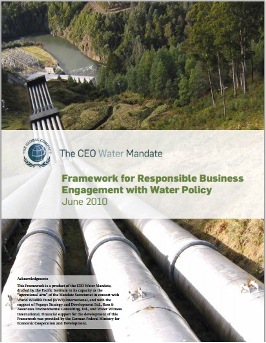
Access to water is an important strategic concern for many companies, but increased threats to the supply, quality, and reliability of global water resources add substantial pressure and immediacy for businesses to improve the way they manage water risk. Recognizing that business, government, and civil society share a critical interest in reducing water-related risks through common solutions, the UN Global Compact’s CEO Water Mandate has released a Framework for Responsible Business Engagement with Water Policy to facilitate effective water policy engagement.
This letter to the Department of Water Resources, Division of Statewide Integrated Water Management, Water Use and Efficiency Branch from …
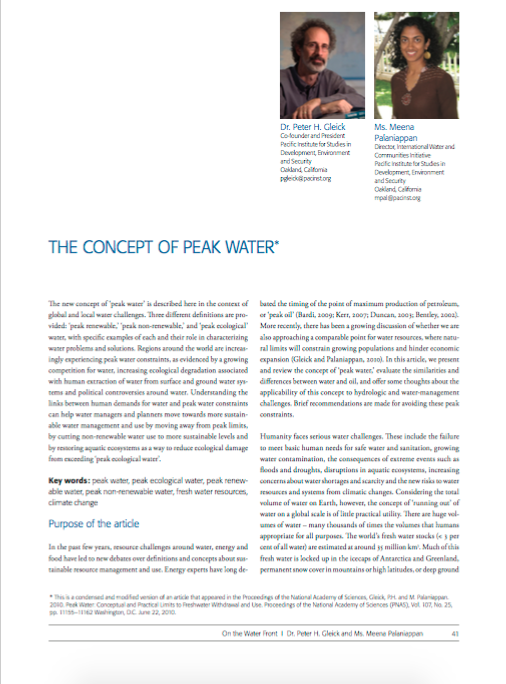
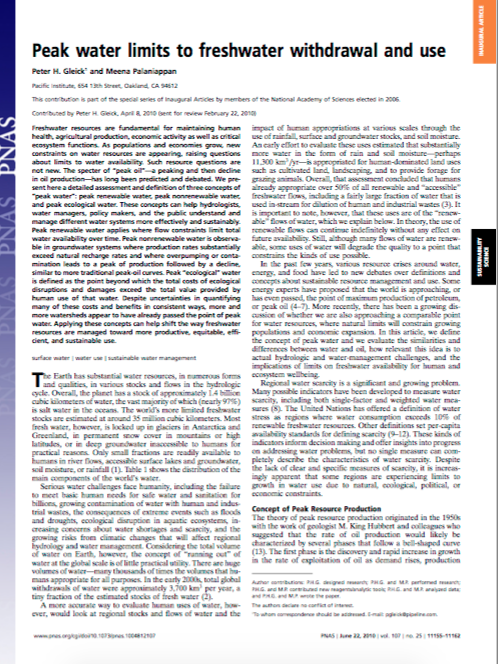
A new journal article from the Proceedings of the National Academy of Sciences (PNAS) highlights new “peak water” limits to global and regional freshwater availability and use. The May 24, 2010 early edition of the journal includes the new article Peak Water Limits to Freshwater Withdrawal and Use by authors Dr. Peter Gleick, president of the Pacific Institute, and Meena Palaniappan, director of the Institute’s International Water and Communities Initiative, and brings sharp focus to understanding the world’s water issues in new terms of “peak renewable water,” “peak nonrenewable water,” and “peak ecological water.”
On the subject of water, three key trends confront us: climate change will affect rainfall and runoff patterns and seriously impact our water supplies both in the United States and abroad; 780 million people in the developing world still don’t have access to clean drinking water – and pressure from pollution, wetland destruction, and climate change is threatening to make this worse; and the dangers of water privatization demand greater scrutiny from governments and the public.
Bottled water is just one aspect of the global water issues Peter Gleick addresses as one of the experts featured in the new documentary Last Call at the Oasis from Participant Media, producers of the groundbreaking documentaries An Inconvenient Truth and Food, Inc. Read Participant Media’s interview with Dr. Gleick on the implications of bottled water here.
Effective business water accounting methods are critical for sustainable water management, according to the new Pacific Institute report, Corporate Water Accounting: An Analysis of Methods and Tools for Measuring Water Use and Its Impact, prepared for the United Nations Environment Programme and the CEO Water Mandate. Current methods are a good start for measuring water use and impacts, but they are inadequate for benchmarking. Advancing effective and coordinated accounting methods for corporate water use and impacts is essential to help companies identify risk, drive improvement, and address stakeholders’ needs.
California’s agricultural industry is a lynchpin of the state’s economy. But the effects of climate change, as well as pressures …
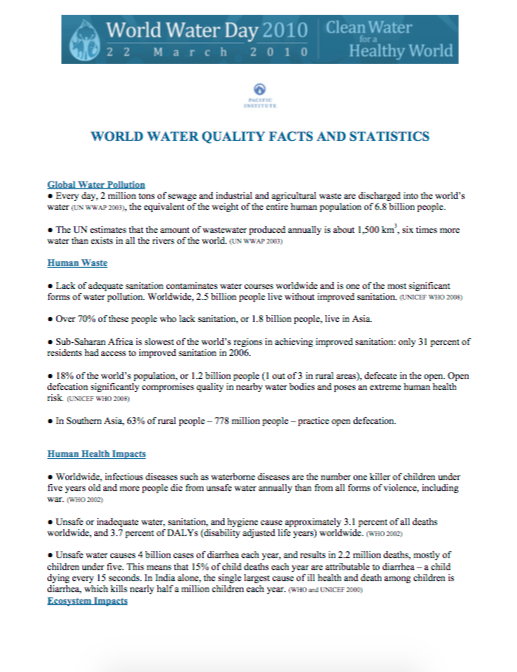
Every day, 2 million tons of sewage and industrial and agricultural waste are poured into the world’s waters. The result is that more people die from unsafe water annually than from all forms of violence, including war. A new Pacific Institute report released by the United Nations Environment Programme (UNEP) for World Water Day, March 22, 2010, lays out steps and solutions to address our urgent water-quality challenges––and they start with awareness and will to action.
The quality of the world’s water is a major global concern. This fact sheet provides facts and statistics on the …
World Water Quality Facts and Statistics – World Water Day 2010 MORE
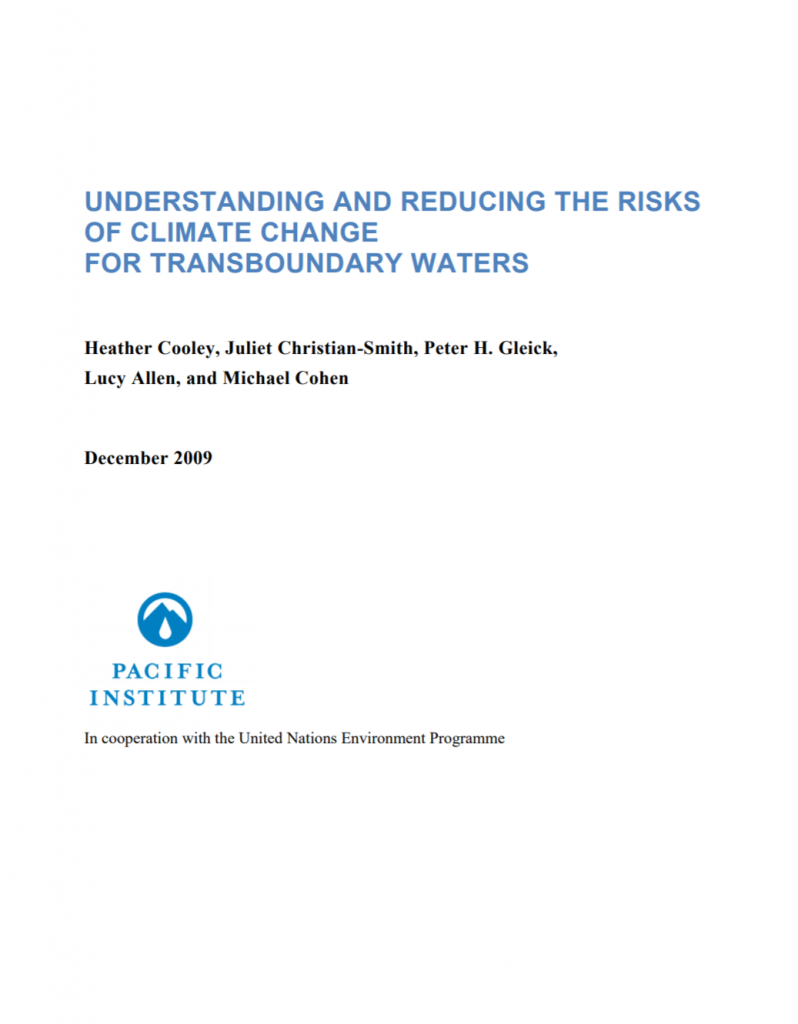
Global climate change will increase the risk of conflict over shared international freshwater resources. Treaties and other cross-border agreements can help reduce those risks, but existing agreements are inadequate for dealing with the impacts of climate change. A new Pacific Institute analysis for the United Nations, Understanding and Reducing the Risks of Climate Change for Transboundary Waters, identifies these growing risks and proposes methods for reducing them.
The Legislature and much of California remain locked in a fight over the future of the Sacramento-San Joaquin River Delta. Not so long ago, there was a similar fight over California’s other major water source, the Colorado River.
Laguna Conceptual Restoration Design Lower Colorado River Task 3 – Final/Preferred Concept and Detailed Cost to the MSCP Planning Team …
In July 2007, the UN Secretary-General in partnership with international business leaders and under the auspices of the UN Global Compact launched the CEO Water Mandate – an initiative established to better understand and advance water stewardship in the private sector. The Mandate was built upon six core elements considered to be critical in addressing corporate water management: Direct Operations, Supply Chain and Watershed Management, Collective Action, Public Policy, Community Engagement, and Transparency.
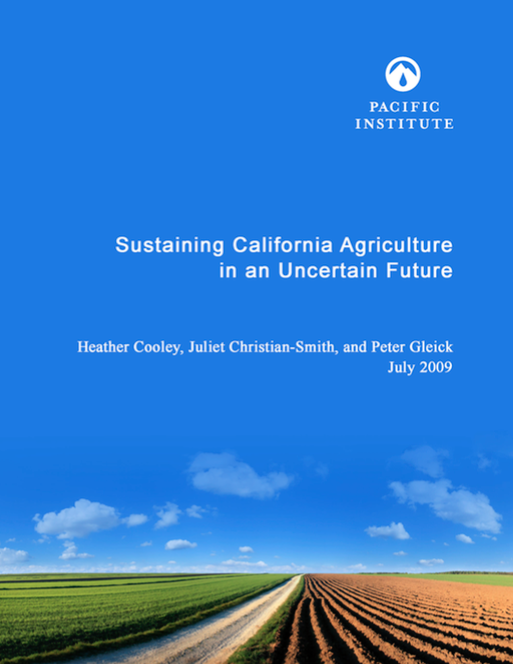
The report Sustaining California Agriculture in an Uncertain Future shows that California agriculture can flourish despite diminishing water supply and future uncertainty from climate change, but it will require great strides in increasing the water efficiency of the agricultural sector.
The preface of the Guide will include a summary of current societal and water resource trends affecting business operations. It will define the origins, scope, and objectives of the Guide, and will provide background on the Mandate and its activities, particularly with respect to its work‐stream on public policy.
Secretary of the Interior Ken Salazar came to California on Sunday to hear firsthand about California’s drought. Unfortunately, some of what he heard was misleading or false. Certainly farms and farmers are suffering, so are fish and ecosystems. But so is the truth. Here are three oft-repeated falsehoods.
Thank you for the opportunity to testify today on the effects of climate change on agricultural production in the United States. Our testimony will focus on those impacts related to water resources – a critical connection especially in the western United States. These detailed comments are intended to supplement our oral testimony.
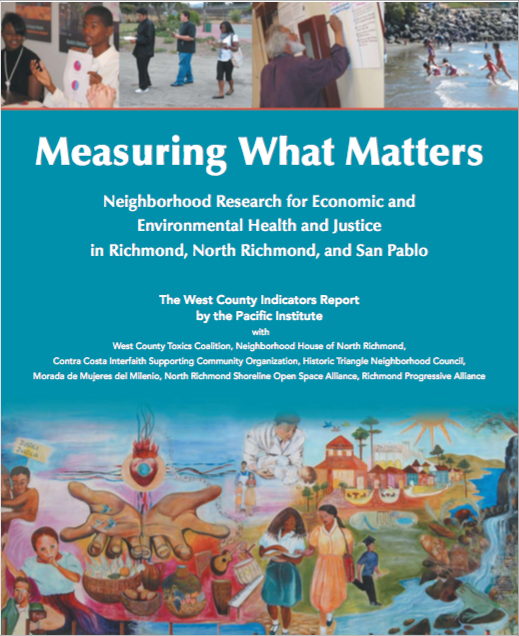
Published by the Pacific Institute and seven local partner organizations, Measuring What Matters: Neighborhood Research for Economic and Environmental Health and Justice in Richmond, North Richmond, and San Pablo quantifies how serious, avoidable problems have become chronic and offers solutions for a better, more equitable way of life in West County.
“Climate Change and the Global Water Crisis: What Businesses Need to Know and Do,” explores the linkages between climate change and water – from both the scientific and corporate management perspectives. Jointly released by the Pacific Institute and the UN Global Compact, the whitepaper covers a number of critical areas, including:
The CEO Water Mandate report, Water Disclosure 2.0 – Assessment of Current and Emerging Practice in Corporate Water Reporting, examines and analyzes corporate reporting on water sustainability for 110 companies across 11 water-intensive sectors. The assessment tracks the six key elements addressed by the CEO Water Mandate: Direct Operations, Supply Chain and Watershed Management, Collective Action, Public Policy, Community Engagement, and Transparency.
In July 2007, the UN Secretary-General, in partnership with international business leaders and under the auspices of the UN Global Compact, launched The CEO Water Mandate – an initiative established to better understand and advance water stewardship in the private sector. The Mandate was built upon six core elements considered to be critical in addressing corporate water management: Direct Operations, Supply Chain and Watershed Management, Collective Action, Public Policy, Community Engagement, and Transparency.