


60 percent
of the world’s freshwater flows come from transboundary waters, making shared water management and cooperation critical for resilience and peace.
Source: UN Water
1 in 4 people
globally still lack safely managed drinking water deepening health, equity, and stability risks.
Source: UNICEF, 2025
420 water conflict events
were recorded in 2024 alone, a 20% increase from 2023 and a 78% increase from 2022.
Source: Water Conflict Chronology, Pacific Institute
THE PROBLEM, RIGHT NOW
Around the world, water is increasingly connected to violence, insecurity, and instability.
- Water can be a trigger of conflict when scarcity, poor governance, or inequitable access deepen tensions.
- Water can be a casualty when water systems are damaged or destroyed.
- Water can be used as a weapon when water resources or water systems are used as a tool to cause harm.
The impacts are often felt most deeply by people whose right to water is most at risk, but no person or group is immune. Water-related conflict can threaten public health, disrupt supply chains, destabilize communities, and damage infrastructure that millions depend on.
Understanding these risks is the first step toward preventing them.
THE WATER CONFLICT CHRONOLOGY
At the heart of the Water and Peace Initiative is the Pacific Institute’s Water Conflict Chronology, the most comprehensive open-source database of its kind.
For more than three decades, the Pacific Institute has compiled, curated, and analyzed incidents where water has been a trigger, casualty, or weapon of violence. This evidence base helps researchers, policymakers, journalists, humanitarian and development organizations, and communities better understand where water-related conflict is occurring, how patterns are changing, and what conditions may increase the risk of future conflict.
Explore the Chronology
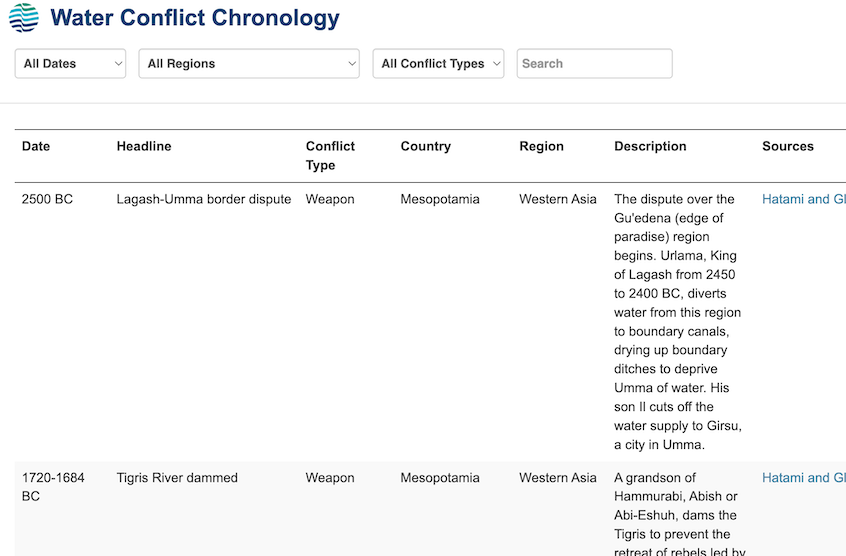

The Chronology provides the empirical foundation for deeper analysis, practical insight, and strategies that can help reduce the risk of water-related conflict and support more peaceful and resilient water systems.
“As water crises accelerate today, they trigger systemic stresses that spark conflict, food insecurity, and human migration. Fortunately, the Pacific Institute helps us learn from past and present water conflicts in order to map paths to a more peaceful, stable, equitable water world in the changing climate.”
– J. Carl Ganter
Managing Director, Circle of Blue
OUR APPROACH
The Water and Peace Initiative connects data, research, and partnerships to help move from understanding water-related conflict to reducing it.


FEATURED IN
SUPPORT THIS WORK
Support for the Water and Peace Initiative helps the Pacific Institute maintain and strengthen the Water Conflict Chronology, deepen analysis of water-related conflict, identify pathways for prevention and cooperation, and provide decision-makers with the tools they need to act earlier and more effectively.
For more information, contact:

Morgan Shimabuku
Program Manager
Pacific Institute
mshimabuku@pacinst.org
GLOBAL MEDIA COVERAGE
Israel attacked Palestinian water sources over 250 times in five years, data reveals
Water-Related Conflict On The Rise Across The World, Study Finds
Global surge of water-related violence led by Israeli attacks on Palestinian supplies – report
Violence over water is on the rise globally. A record number of conflicts erupted in 2023
War, Drought Cause Spike in Violent Water Conflicts
Water In Conflict Is Increasing
Water and warfare: the battle to control a precious resource
Russia and Israel lead global surge in attacks on civilian water supplies
It’s Not Just Iran: Conflict Over Water Resources Is on the Rise – The Good Men Project
Water wars: The new normal? | Nagaland Post
War takes toll on Ukraine water infrastructure and environment (esemag.com)
War in Ukraine threatens freshwater resources and water infrastructure (smartwatermagazine.com)
Sharing cross-border water resources: Cooperation or conflict? (dhakatribune.com)
Climate change is making armed conflict worse. Here’s how. – The New York Times (nytimes.com)
RESOURCES
- As water becomes a weapon of war, we must focus on cooperation and peace
- Impact of the Russia–Ukraine armed conflict on water resources and water infrastructure | Nature Sustainability
- Water-related conflicts: definitions, data, and trends from the water conflict chronology | IOPscience
- Rivers and Water Systems as Weapons and Casualties of the Russia‐Ukraine War | Gleick – 2023 – Earth’s Future – Wiley Online Library
- Full article: The destruction of the Kakhovka dam and its consequences | tandfonline.com
- Op-Ed: Protecting the Environment in Times of War | Pacific Institute
- Pacific Institute Analysis Finds Surge in Reported Water-Related Violence
- 2023 Was a Record Year for Violence Over Water Resources Across the Globe
- Violence over Water Increases Globally According to New Data from Pacific Institute Water Conflict Chronology
- Water Conflicts Worsen: New Pacific Institute Analysis Identifies Hundreds of New Instances of Violence over Water Resources
- New Water Conflict Prediction Tool Uses Data from Pacific Institute’s Water Conflict Chronology
- Violence over Water Increases: New Data from the Water Conflict Chronology
- Pacific Institute Statement on White House Action Plan on Global Water Security
- Water Needs Peace
- Ending Conflicts Over Water: Solutions to Water and Security Challenges
- Water, Security, and Conflict
- Understanding and Reducing the Risks of Climate Change for Transboundary Waters
- A New Vigilance: Identifying and Reducing the Risks of Environmental Terrorism
- 2025 Fact Sheet
- 2024 Fact Sheet