


Authored by Heather Cooley, Chief Research and Program Officer
2025 marked a turning point in how water risk is manifesting across the globe. Our most recent update to the Water Conflict Chronology highlights how violence related to water is on the rise, set against the backdrop of worsening climate impacts and aging water systems. Communities around the world continued to experience these realities firsthand, from intensifying droughts and heat waves to infrastructure pushed beyond its limit.
And yet, alongside these challenges, we saw new momentum, stronger partnerships, and a growing recognition that water is foundational to both community resilience and economic stability.
For me, this is a reminder of the need to remain steadfast in our resolve to advance solutions to our most pressing water challenges. The Pacific Institute’s unique role in advancing evidence-based strategies that ensure people and nature have the water they need today, and that future generations can rely on tomorrow. As we enter 2026, I want to share a few milestones that illustrate where we are headed.
Advancing Water Efficiency and Reuse
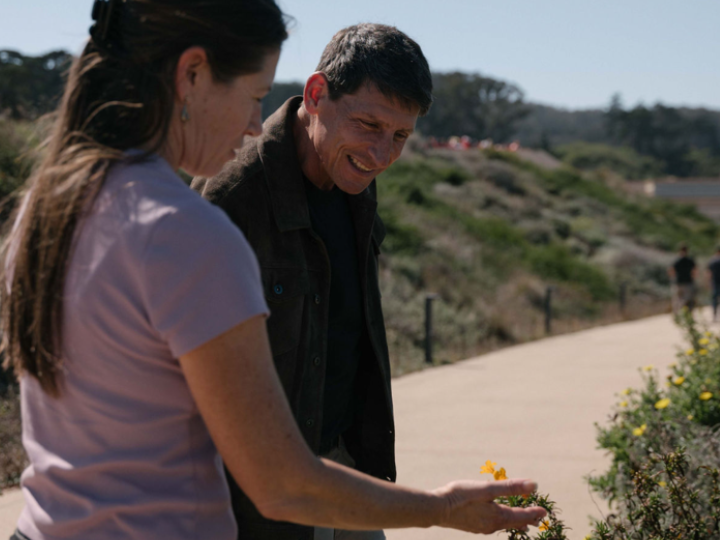
A major achievement of 2025 was the release of first-of-its-kind national water efficiency assessment, which shows that improving water efficiency in U.S. homes, businesses, institutions, and reducing leakage in distribution systems could reduce municipal and industrial water by 25% to 60% using existing technologies and practices. The study calls for elevating water efficiency as a central element of water management and recommends increasing investment in efficiency programs; strengthening regulations for fixtures, landscapes, and buildings; expanding education and outreach; and integrating efficiency savings into infrastructure and financial planning.
The study is part of the Pacific Institute’s ongoing research advancing water efficiency and reuse strategies to build water resilience in the United States and globally. It follows the Pacific Institute’s 2024 groundbreaking report, “Untapped Potential: An Assessment of Urban Stormwater Runoff in the United States,” and precedes an upcoming study on the national potential for municipal wastewater reuse.
These national findings matter most when they inform action on the ground, particularly in communities where efficiency gains can deliver both water savings and affordability benefits. Our collaborative project with the Housing Authority of the City of Los Angeles, Sensor Industries, and the Bonneville Environmental Foundation demonstrated what collaboration makes possible. By installing more than a thousand leak-detection sensors across affordable housing units, water use declined by 10%. This saved millions of gallons and reduced costs for residents. The project received the 2025 One Water Award as well as the Los Angeles Better Building Challenge award, and is an example of how technology, evidence, and equity come together to create measurable impact. Building on this momentum, we are expanding this work in Los Angeles and other western cities in 2026, applying these lessons at a larger scale.
Strengthening Water Equity
Last year we deepened our commitment to frontline communities, ensuring they have the tools, resources, and strategies needed to navigate the realities of a changing climate.
As part of our long-standing partnership with DigDeep and the Center for Water Security and Cooperation, we launched Achieving Equitable, Climate-Resilient Water and Sanitation for Frontline Communities. This national assessment offers more than 100 actionable strategies for frontline communities’ water and sanitation systems. The report was shared widely in the media, including by the Associated Press, which featured the groundbreaking approach to uplifting community voices and identifying practical solutions.
Building on this momentum, we released Strategies for Resilient Rural Water and Sanitation. This report addresses a significant knowledge gap for rural systems by outlining 130+ strategies tailored to small and under-resourced communities. Later in the year, we published the most comprehensive legal framework to date for assessing whether U.S. laws enable, or hinder, climate-resilient water and sanitation systems.
This stream of our work reflects thousands of hours of analysis, modeling, and collaboration. And just as importantly, we are now seeing these insights turn into tangible outcomes. Looking ahead to 2026, we will be developing new decision-support tools and community-facing resources to help frontline communities assess climate risks and identify the most effective adaptation pathways.
Leading at the Salton Sea
Thanks to continued support from our partners, the Pacific Institute has maintained a steady presence at the Salton Sea for more than 25 years. This year, we saw encouraging signs of progress including the state filling 2,000 acres of new habitat ponds, and the creation of the Salton Sea Conservancy with dedicated state resources.
We continued working closely with state agencies and local partners through advisory committees and working groups to advance projects that benefit at-risk and migratory species and reduce harmful dust from exposed lakebeds.
In 2025, we also released Breathing Hazard: Air Pollution in the Salton Sea Region, highlighting the growing air-quality risks faced by more than 500,000 residents of the region and calling for urgent action to protect public health. This Reclamation-funded study assessed the many sources of air pollution in the region and recommended a coordinated effort between state and local agencies, public health experts, and community leaders to direct additional investments toward exposure control strategies to optimize public health benefits.
Mobilizing Collective Action Across Basins
Another encouraging trend this year was the growing momentum across basin collaborations. This year, the Pacific Institute supported collaborations across 16 river basins worldwide, providing the science, convening platforms, and decision-support tools needed to move from individual corporate commitments toward more coordinated action.
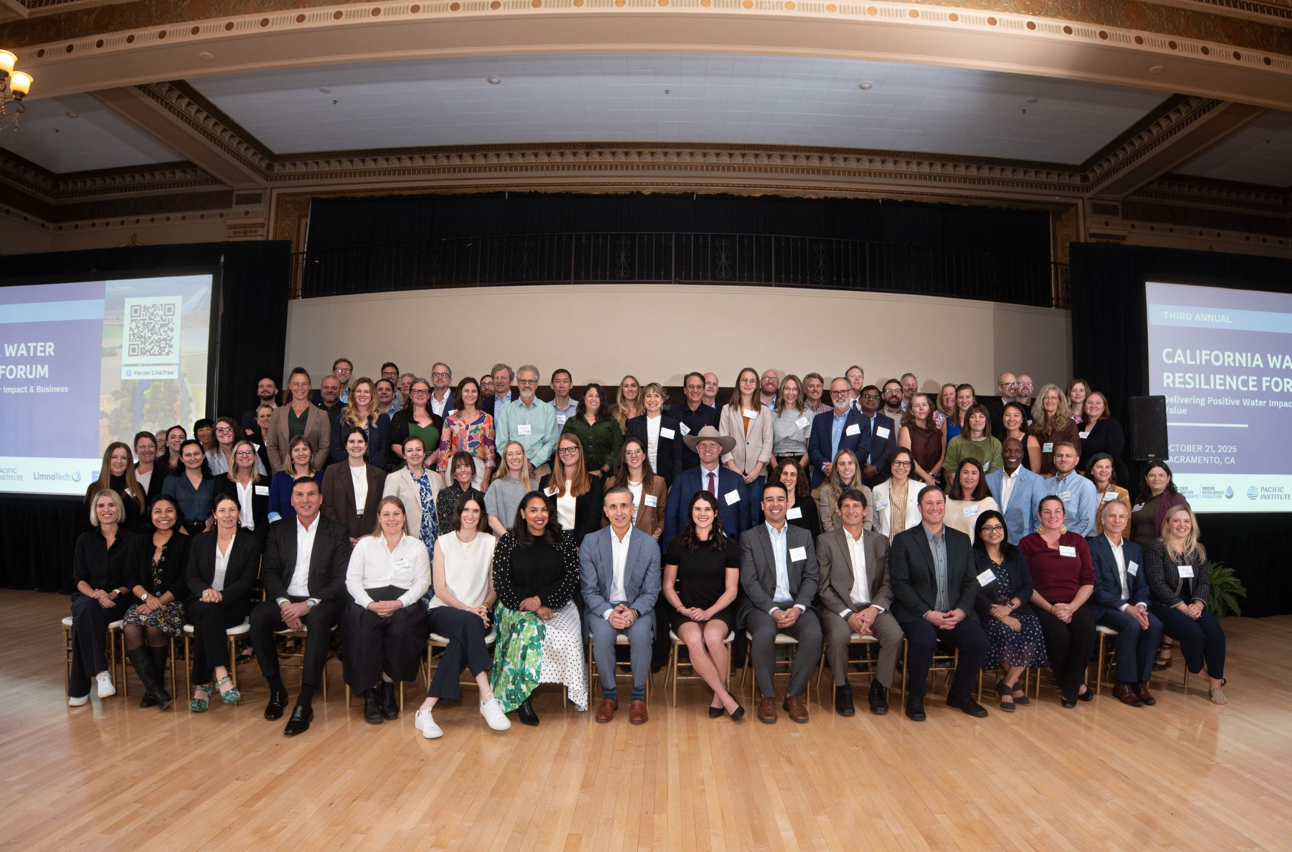
In 2025, we continued leading the California Water Resilience Initiative (CWRI), convening more than 100 leaders from business, government, philanthropy, and civil society for the 3rd Annual California Water Resilience Forum. CWRI is a powerful demonstration of growing private sector engagement in long term water resilience strategies.
We saw similar momentum in India, where basin partnerships in the Godavari and Yamuna continued to mature, and we are seeing promising new opportunities emerging in the Orange, Java, Maipo, Colorado, Meghna, and the Thames basins.
At the core of this work is a simple premise that collective action requires a shared understanding of the risks, opportunities, and progress. By applying the latest science and data, we help partners identify where water systems are most vulnerable and where coordinated investment can have the greatest impact.
Why This Moment Matters
As I reflect on 2025, what stands out most is not just what we accomplished, but how we accomplished it. We achieved it through deep partnership, scientific rigor, and a shared belief in what is possible.
We are at a pivotal moment for water. The challenges are real. But so is the momentum.
Thank you to our partners and funders for being part of this work. Your support enables us to build the evidence base communities rely on, develop tools that turn knowledge into action, and convene leaders who share responsibility for our water future. Together, we can ensure that water, essential to every aspect of life, remains secure for all people, ecosystems, and generations to come.