

This blog was written by Sarah Bardeen, Senior Center Communications Manager for Public Policy Institute of California, and was originally published on PPIC.org
Managing the Salton Sea remains a thorny issue for California. We spoke with Pacific Institute’s Michael Cohen and UC Riverside’s William Porter about recent research that might point toward cost-effective ways to protect public health.
Tell us about Pacific Institute’s most recent study on the Salton Sea. How does this study differ from previous reports?
Michael Cohen: In the past three to four years, there have been strongly worded news articles saying that the Salton Sea is a toxic sump that’s killing people. That’s exaggerating how bad the situation is. While a smaller and increasingly degraded sea does pose health risks to surrounding communities, many people don’t recognize the Salton Sea’s ecological value or the ecosystem and health-related benefits it provides by limiting dust emissions.
We put out three reports, starting back in 1999, that alerted people to some of the coming challenges of the Salton Sea but also highlighted its value. Our most recent report puts Salton Sea pollution in the context of other air quality challenges within the region, which we define as stretching from Palm Springs to the Mexican border. These include agricultural burning, diesel emissions, and truck traffic on I-8 and I-10.
This report tries to synthesize what other reports are saying about pollution sources in the region. We wanted to raise the question of what’s the best use of limited public funds.
The report seems to say that reducing dust emissions from the sea itself would be challenging. What measures can residents take to help reduce exposure?
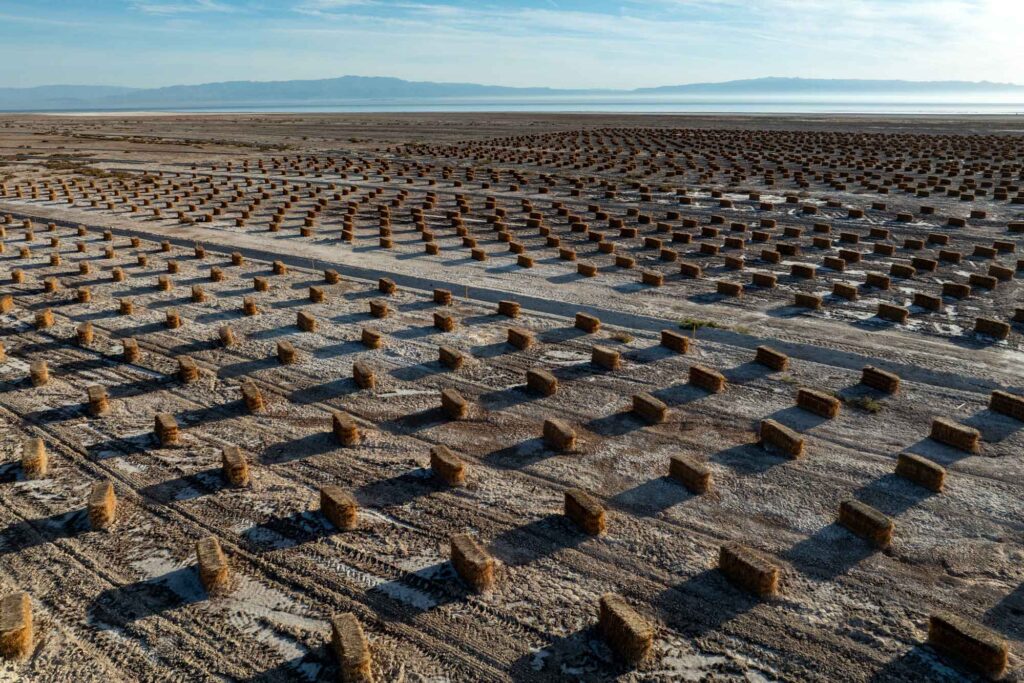
MC: Currently, the state is spending tens of thousands of dollars per acre to manage emissions from the exposed lakebed by putting straw bales out on the ground and doing surface roughening. The Imperial Irrigation District and the state both have about 3,000 acres each of dust-suppression projects, with a total cost of over $100 million dollars.
This work is only dealing with the potentially contaminated dust coming off the lakebed, but there are so many other sources of pollution that affect health as well. There may be other, more effective ways to reduce exposure, such as weatherizing homes (sealing cracks to prevent drafts) and putting air filters in homes and schools. These options may be more cost effective and beneficial to folks who live there.
Will Porter: Indoor air filtration is a new area for public health awareness, but it’s a way that we believe individuals, families, residents, and communities can take some control over the air quality they’re exposed to in their homes and workplaces. It’s not a complete fix, especially for people who work outdoors, but it’s a way to get the most bang for your buck when it comes to improving air quality where people are for the most hours each day, which for many is indoors.
I’ve been exploring ways of improving indoor air quality at a low price point. I’m working on some projects right now that look at how much dust could be controlled indoors using $80 filtration boxes that folks put together at workshops we held in the region. Analysis of this pilot project showed there was a drastic reduction in the amount of exposure just from this relatively low-cost intervention.
What sort of policies could better address community health issues around the Salton Sea?
MC: In late 2017, the California legislature enacted AB 617, which looks at the public health impacts of air pollution on disadvantaged communities. There are three AB 617 communities in the Salton Sea region. The communities went to the California Air Resources Board (CARB) and submitted action plans. Then they got some funding and started implementing various pollution control projects.
They are distributing air filters, weatherizing homes, paving roads, and addressing pollution sources. That’s a big investment, but there’s not a lot of coordination between the AB 617 process and state and regional Salton Sea management processes.
Many sources of air pollution affect residents, but these sources fall under different jurisdictions. Our report highlights the need for a more coordinated approach that brings together agencies and stakeholders to talk about what they’re doing, find synergies, and leverage funds to better address these problems.
WP: While the Salton Sea has unique traits, it’s not the only place in the world where lakes are drying up. Similar scenarios are happening all over the world.
One positive takeaway is that we know a lot more about the system than we did 20 years ago, and that’s empowering. When we’re able to correctly identify the pollution sources driving the high rates of asthma, respiratory issues, and hospitalizations in the Salton Sea region, we can find better and more effective strategies for managing them. I’m in this business because I believe knowledge is power, and that knowing things helps us fix things.